
AI Productivity Paradox
People keep reporting productivity gains, but executives are reporting the opposite. Why?
C-levels Aren't Happy
Okay, are they ever?
However, I agree with them on this one: Fortune recently reported 90% of executives say AI hasn't boosted productivity. How about 95% of enterprise AI pilots return nothing? How about spending isn't justified as companies have to rein in AI spending?
Wait… but AI is supposed to make us more productive? I mean I know Jensen says we should be dropping $250k/yr per dev in token usage, and that software engineers should be pulling $500k/yr… so why aren't we seeing companies gladly throw more money at the productivity machine? That's obviously the correct move if every piece of labor is cheaper through it.
But… My Productivity Seems Increased
Now before we dive into this, I'll preface this with an assumption: the shift in how my workflow goes may be biasing my stance. Some of the more stressful/grueling parts are less of a problem now, experimentation is cheaper, no longer a major consideration in solution finding…
With that in mind, depending on the task, I'm probably anywhere from 2-3x slower to 20-500% faster.
- For slinging basic UI around, something that's code-heavy but cognitively light, things get done way faster.
- As the complexity goes up for the actual task at hand, the gap closes. LLMs are more likely to make errors, introduce more problems down the road, need more guidance, or recommend bad approaches.
- There is an inflection point where I've had tasks take longer on LLMs than doing it by hand. You learn which tasks those are, bail early, just make the change by hand, etc.
The important part is figuring out where the tool lands on helping early on, and deciding what level of leaning on it you'll use. This varies by task. The number of times we have a task to do and Claude wants to hand-roll an entire module where a lib already exists that is built explicitly for this task is staggering. This increases our overhead and introduces bugs. Sticking my hand in the spinning machine to stop it and tell it "no no, go use this lib" saves us a ton of effort (and funny enough, tokens).
But overall, I feel significantly more productive, even if it's just because I can work and focus more on said work because the cognitive load isn't wasted on fiddling with layout because I wanted to add a dialog box.
So Where Is The Productivity Going?
RoushTech has a pretty strict policy about how we can use AI in our work. What we're aiming for is two major parts: first, a customer should not be paying for slop, and second, the team shouldn't have to tolerate the additional overhead you add by behaving like this.
People who act as human-to-LLM interfaces externalize a massive amount of cost. To the point where businesses need to adapt by updating their workplace policies so that this is behavior that leads to termination.
"Human-to-LLM interface"? This is the kind of person where you have a problem with their code, you write up a couple paragraphs of questions. They take it, copy it, paste it into an LLM, get the response and paste it into an e-mail back to you, and then click send. They have added exactly zero value to this process while making it massively slower.
The ignorant manager: "wow they're fast"
Anyone that has to deal with this: they're spending a ton of extra time babysitting this person. LLMs work best under pressure, having their defaults challenged and being guided. This kind of blind handoff in both directions doesn't even allow the LLM to actually work effectively. On top of that, LLM output is rough, it's clearly not in your voice, it's typically in a context that is awkward to grok, and will introduce way more of a tax sending 2-3 pages of Claude output instead of 2-3 sentences just explaining what you did…
Which on that point, now you have an expensive engineer that… actually doesn't know what they did. That is not worth anything. If I want people to copy/paste between prompts, I got a lot of kids out of high school that can do that. There is zero reason to pay expensive salaries for that… shoot, and that's before we even get to "I might as well just orchestrate agents myself".
I refer to these people as "black holes of productivity".
The 4 Types Of Worker
The "4 classifications of officers" is commonly attributed to Kurt von Hammerstein-Equord, an interwar German general. I've brought it up with Zech Sloan and James Anderson a lot, and I think it applies just as well to workers.
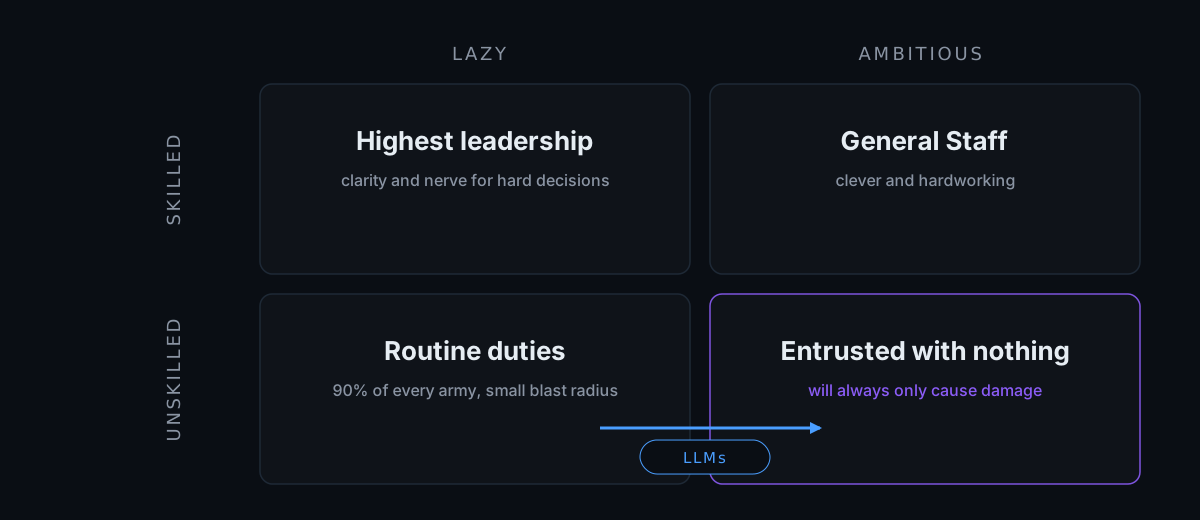
I distinguish four types. There are clever, hardworking, stupid, and lazy officers. Usually two characteristics are combined. Some are clever and hardworking; their place is the General Staff. The next ones are stupid and lazy; they make up 90 percent of every army and are suited to routine duties. Anyone who is both clever and lazy is qualified for the highest leadership duties, because he possesses the mental clarity and strength of nerve necessary for difficult decisions. One must beware of anyone who is both stupid and hardworking; he must not be entrusted with any responsibility because he will always only cause damage.
LLMs have done something massively dangerous here. They've taken the unskilled and lazy worker, and made them incredibly ambitious, the most dangerous kind of worker. These people can create much more work for everybody around them. Every piece of work they do is effectively collateral damage to the rest of the team.
Before LLMs, the lack of skill limited their ability to actually do work. Their blast radius was small and cycle times were measured in days and weeks. Their slowness was a feature.
Why The LLM Fails
One of the most common things that we've seen is an LLM will take every piece of feedback and turn it into an immediate and aggressive action. The default to "hey what do we do if $x happens" becomes code in our code base that requires upkeep and may introduce bugs. We've caught many of these situations causing bugs before they ship to production. We had Claude offer to add complex state management for a bug that's already fixed! But you know… in Claude's mind (to anthropomorphize it for a moment), "just in case".
There's a cascade of other issues LLMs will present. We had Claude take our staging environment offline due to a relatively boneheaded mistake on its part. It then spent over half an hour misdirecting us until I stepped in and found it in two commands.
I have endless stories just this month alone, on Fable, the model that was supposed to be crazy good.
These failures are basically the reason we hire humans and delegate. This goes back to basic business 101: you delegate because to do otherwise requires you to have infinite time to do all of the work. This delegation is only valuable if another person is putting their time into making sure things work.
If your meat proxy is just going to accept whatever Claude outputs, you're getting zero value off of delegation.
The Slop Grenade
Tobias Lütke of Shopify had recently talked about "Slop Grenades" which I think is such an accurate term for it. A pin is pulled, it rolls into the room and everyone else pays the price.
While Tobias is a bit bitter about people poking fun at him for promoting AI in the way that led to slop grenades being the norm (he argues he never told people to use it poorly…), the problem is industry-wide and deep-rooted in the complexities of the people who make up the work force.

What The Industry Needs To Do
The problem exists because our social expectations at work have not caught up with the new type of work being done. This leads to a massive asymmetry of expectations and a time sink where there originally was not one.
We need to stop tolerating the unskilled and ambitious. They're now actively holding teams back.
RoushTech has a very simple approach to this, and it's a Human Resources one: if you are actively a detriment to your team because you're being lazy, you get put on a Performance Improvement Plan, and if you don't stop, you will be terminated.