
AI Is Giving Us Engineers More Work, Not Less
Over two decades in and my backlog has never once been empty. AI hasn't replaced engineers or made anyone a 10x dev, it just made the small stuff cheap enough that there's way more of it to do now.
The Narrative
So we've seen it all over social media, every engineer can be a 10x engineer now, get rid of 90% of your team, no wait software engineers are cooked, everyone can be a 10x engineer now! Actually just get rid of your engineering team!
But it's been over 3 years of this, Devin AI, the AI to "replace all devs" has been out for over 2 years, and where are we really today?
Learning Programming Languages Was Never The Barrier
I've picked up languages in a few days, I have over 15 under my belt, many engineers are thrown at languages that were developed for specific platforms, shoot I've seen projects where all-too-silly engineers developed their own language then used it at work.
Zech Sloan was nearly hired a few job placements ago to lead a Ruby team - zero Ruby experience, the founder wanted his technical acumen that badly, the language didn't matter, the skill to make well informed and solid decisions did. Zech turned down the offer.
At the end of the day, learning how to write an if statement wasn't the big barrier that AI influencers want you to believe. What is basically being said is "oh look, now people who can't be bothered to put in a little bit of effort can do this too!", that's not a good thing.
10x Development!
Are engineers hitting 10x productivity? No not really, we've seen a lot of projects still crawl, releases aren't that frequent, road map is still way behind schedule, us as users, owners, or investors are left still just waiting.
We're seeing no renaissance of software - have we seen 20 years of software development in the past 2? No, not even close. If anything we're seeing an unprecedented slump in software quality. Windows had one of the worst rollouts since Vista, and Vista had an excuse! AWS has gone down at least twice due to AI-assisted deployment changes. Cloudflare's AI-driven Bot Management system took down a chunk of the internet. These kinds of incidents during the "Boring Cloud" last decade would get people fired.
We do see some software building fast, stuff like OpenHamClock is a decent example, but I ended up not using it because it kept changing frequently, branched from the original app it replaced (functionality wise), and kept adding so many random things it made what use I got out of it less useful.
OpenClaw is a new flavor of abandonware: endless issues generated by bots, bots endlessly PRing against broken builds, activity everywhere and care nowhere, the bots just make the project worse continuously, this is the 10x you get.
Have Non-Engineers Write Code!
I love how I'm watching the flavor-of-the-month tell teams to do this, guys we just came out of low/no-code. We just experienced what happens. Engineers aren't just English -> Code translators, a good team pushes back, a good team understands the industry, a good team guides product development to be better.
We have seen zero people handle this for anything non-trivial. No/low code has always had a very important role, are you a mom and pop shop that needs something that's better than an Excel spreadsheet? Low/No code works great for this, when your budget is $100 and your own time. I think Vibe coding still sits in this comfortably, can you reach further? Yes. Will it bite you? Even worse than old low/no code did.
I personally have had multiple projects come to me from individuals taking the bait on this, usually the story is the same: "this is a nightmare to work with, I need [quote a 5-figure number]", what people don't understand is a few very clear problems:
- As a non-engineer these platforms will let you do terrible things
- They have a tendency to make a mess of the code base by default
- They're immensely fragile, usually that's why you've reached out, because you've gotten to the point where you can't fix anything without breaking something else
- Me re-architecting this is a lot of work, not only time wise, but it's stressful and some of the worst work to do, that'll come at a premium
We Were Never Short of Work To Do
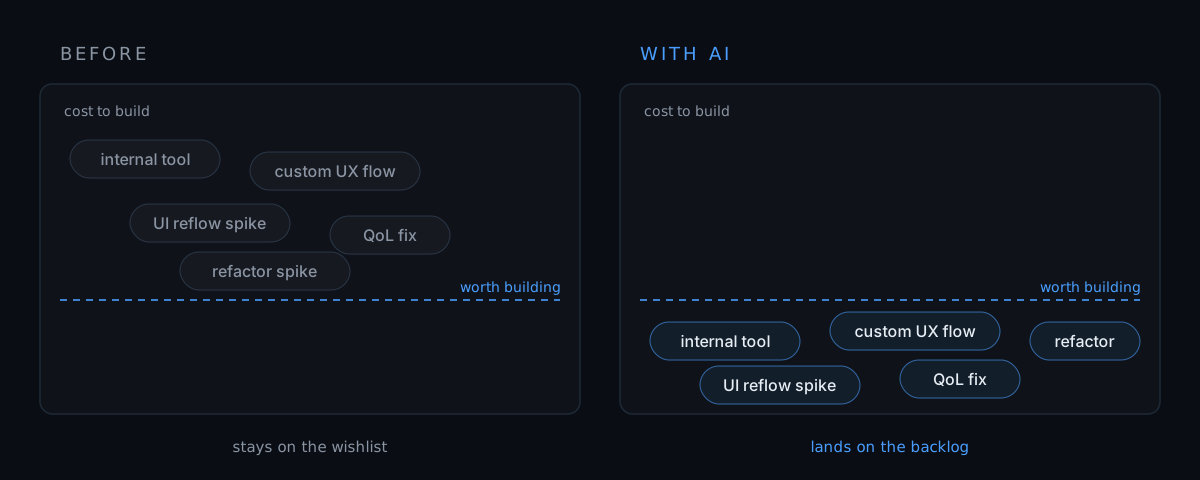
And the biggest point, I've never, in over two decades of professional software engineering, ever been close to not having a backlog, not only that, AI allows us to consider SO MUCH MORE on our backlog.
- Need a tool to do something? Build it, the cost to do things manually instead of having this tool has compressed greatly.
- Would a UI flow catered to this specific flow be better than using the already-existing flow? Do it, it's a better UX, cost is no longer the major barrier for these little UX improvements.
- Want to reconsider a UI reflow because we've been adding features? The cost of prototyping it just fell through the floor, see if anything sticks.
- Quality of life improvement? A must-have now. I have more flexibility to wager if we can fit it into the pipeline.
- We need to refactor this code? I can prototype those refactors quickly, for trivial-but-heavy moves (lots of code but easy approach) LLMs will make quick work.
No, Tests Don't Save You
I don't care what anybody says, I've watched multiple teams do this, and I've experienced it myself multiple times, on every project without manual review and correction the same thing holds true: Claude will lie. Claude will build tests that are useless, it'll inflate that test count quickly, but your software will still be amazingly fragile.
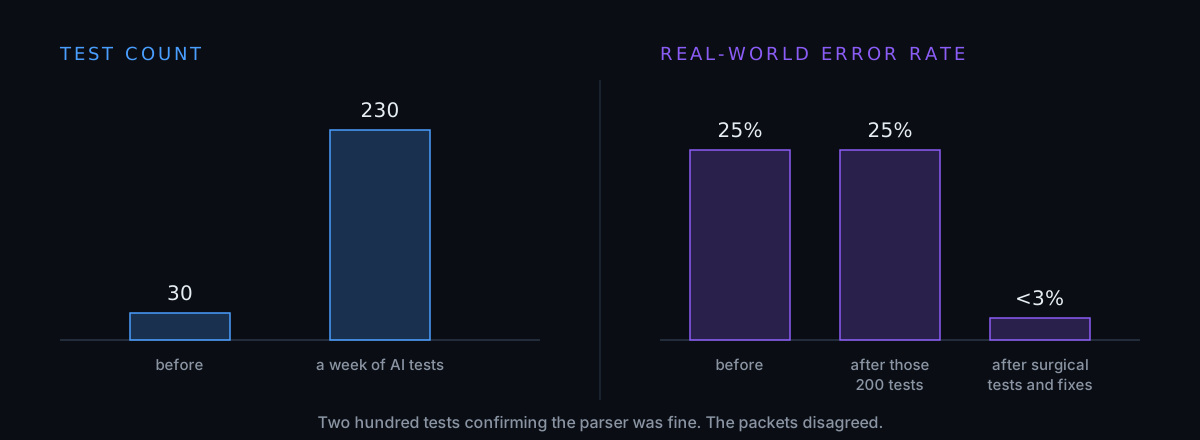
- I've had Claude generate hundreds of tests, we went from 30 -> 230 tests in a week, confirming payload parsing was good, real-world testing showed 25% error rate, I had to go in and very surgically build tests and fixes, reduced it to <3% (packets outside of spec, so honestly effectively a 0% error rate). Those 200 tests dedicated to packet parsing were checking garbage.
- We had a documented specification
- We had over 25,000 example packets
- Claude was given clear instructions multiple times, including leveraging the packet dumps to find parsing errors
- Claude still helped - but required significant hand-holding to get it to actually do what we wanted it to and many iterations of useless tests
- I still don't entirely trust the new test suite now, how many of those 200 tests are redundant? How many could I trim and lose nothing?
- One of our colleagues gave Claude the job of generating regression tests for a major refactor they were doing, they had to fight with it a lot to keep the tests on-track
- I've had to argue with Claude to not create overly-fragile tests.
- We had worked on a data issue for one of our platforms, where we had Claude write a test to confirm a bug was fixed - we wanted Claude to check two reports against each other, explicitly checking the report results, but it decided to write a 40 line internal-gut-checking test instead of the 5 lines of "did this function output match this expected value" (it also ended up not doing it right and passing when it should have failed, resulting in a bug in production persisting)
You can always roll around and say "well you have to…", no, over all the projects I've seen, everyone is doing this wrong, and those telling me I need to hold it sideways? I bet they're doing it wrong too.
The People Saying It Has a Low Error Rate Are Insane (and bad at their jobs)
This comes in from the test portion above too, so I get a number of people, usually people that are coding with mostly vibes, who insist Claude isn't making mistakes – now this doesn't pass a simple logic sniff test (most engineers don't pass one in general), how do you validate something that you don't spend the time to validate because you "trust" it?
Well I have it test itself
That… is stupid, you have to assume the tests it's generating are good to begin with.
The problem is we do check, and we do correct, A LOT.
Well you need to make agent personas
OK, see that's the thing, I did that, I spent a bunch of time going down that path, building a team to handle some basic tasks. I gave it a task to do, it eats 70% of my tokens for the day (OK it was a large task), I review the output, out of like a 20-point list, assumption 2, a basic assumption, was massively wrong. Like "it didn't even try" wrong.
I'm not spending those tokens, that downtime, on that. Sure if it isn't your money, your time, your chair spins while your employer pays you, have at. It's my time, my money, my investments.
This behavior is a known psychological concept: Automation bias. It's people's tendency to believe the computer, we've seen it a lot recently - police and hotel staff trusting AI algorithms that are plain-as-day misidentifying a person. We've seen it in data analytics, a bad number is spit out and the majority of people will trust it instead of saying "this doesn't look right…". Machine learning is super nasty in a way people aren't used to, it has a very atypical state when it "isn't working" – when a program fails to run, we usually expect it to crash or error, ML algorithms will just display bad data basically every time. Its failure state isn't a nice pop-up error message, it just lies.
But the Job Market
Job markets are complex and multi-faceted, we're coming off the heels of COVID era ridiculousness, people coming out of high school saw "hey, get a 6 figure job as your first job", those are the fresh people hitting the market today as juniors.
That was not sustainable, nothing about that was, people predicted "this is the new norm", none of it was (keep that in mind when the same people are predicting AI too).
- We have a significant number of tourists; people who are effectively only here for a 9-5 job and couldn't care less, they always underperform people with a passion for the work by a significant margin
- Companies (especially startups) practiced IT-heavy hiring, effectively over-hiring because big IT teams always seemed impressive (though more likely a dysfunctional team)
- The end of low interest rates reduced the available cash to be thrown around (almost for free) for investments
- There is a bit of "follow the leader" on seeing that you can cut your IT team and "totally not have a problem" (we saw this start with Elon Musk and X, the main fallout I was worried about: people thinking X wasn't in a unique position of gross over-hiring)
- There is some flow back to outsourcing, mostly to low bidders, we know what that gets us in the long-run (it's why we keep ebb and flowing back and forth)
The above isn't AI, AI has been an excuse to try to keep investors happy, vs. "we're preparing for not-so-great performance soon".
AI Doesn't Leave Us Less Busy
Maybe for some, who see it as a 15 minute break 10 times a day, for me even if I'm chugging on something big, I'm spinning around to do a bunch of smaller "light-duty" work that wasn't possible to fit into budgets before. I'm constantly busy, with a backlog we still cannot get all done. I am still 100% budget constrained, and a lot of this work on our backlog is revenue generating, or cost cutting. It's stuff with tangible business value.
And I've never had it any other way in 2 decades, I don't feel AI is changing that.